Doodle Videos vs. Traditional Marketing Videos: Which Is Better for Your Business?
Video has become one of the most versatile tools businesses can use to communicate with potential customers.
But deciding to use video is only the beginning.
The next question is:
What kind of video should you create?
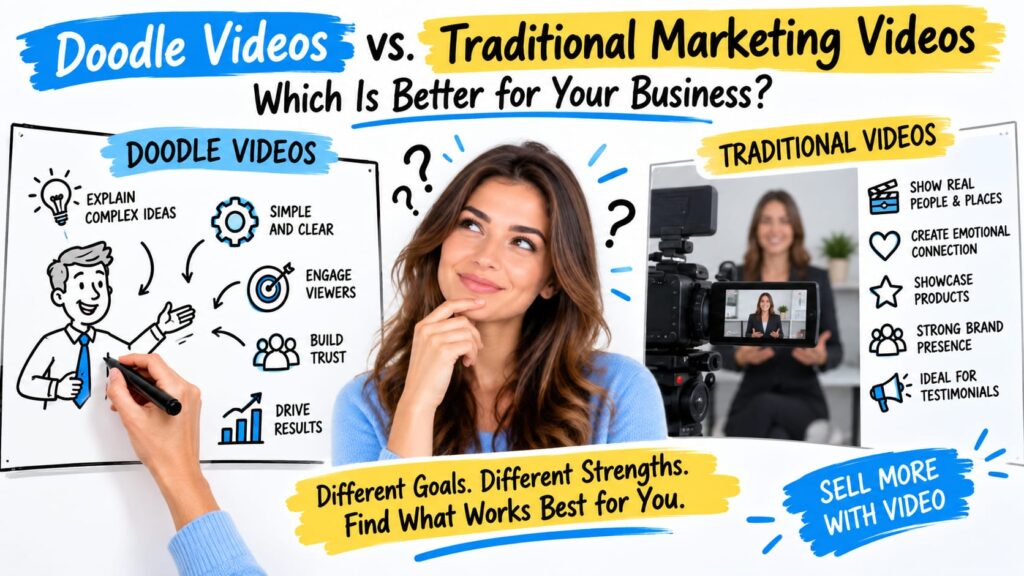
A polished traditional marketing video with filmed footage can look impressive. A doodle or whiteboard-style video takes a completely different approach, using illustrations, movement and visual storytelling to explain a message.
Neither format is automatically better in every situation.
The right choice depends on what you are trying to communicate, who you are trying to reach and what you want the viewer to do next.
Let’s look at the differences.
What Is a Doodle Video?
A doodle video uses illustrations, icons, text and animated visual elements to tell a story or explain an idea.
Instead of relying primarily on filmed scenes, the viewer watches concepts develop visually.
This makes doodle videos particularly useful when the main objective is explanation.
For example, a business could use a doodle video to show:
- How a service works
- Why a particular problem occurs
- How a product solves that problem
- The steps in a process
- The benefits of an offer
- A comparison between different options
The visuals support the explanation instead of simply providing a background for it.
What Is a Traditional Marketing Video?
Traditional marketing videos can include filmed people, locations, products, interviews, demonstrations or professionally produced scenes.
Think of a company introduction, television-style advertisement, customer testimonial or lifestyle product video.
These videos can be extremely effective when the viewer needs to see something real.
A hotel may want to show its rooms.
A restaurant may want to show its food.
A clothing company may want customers to see its products being worn.
In situations like these, real footage has an obvious advantage.
The Biggest Difference: Showing vs. Explaining
One useful way to compare the two formats is to ask what the video needs to accomplish.
Traditional video is often excellent at showing.
Doodle video is often excellent at explaining.
Imagine a real estate company.
If it wants to showcase a luxury property, real footage is probably the obvious choice.
Customers want to see the property.
But imagine the same company wants to explain its five-step process for helping homeowners sell their property.
Now a doodle explainer video may make much more sense.
There is no universal winner.
The purpose determines the format.
When Doodle Videos Have an Advantage
1. When the Offer Is Difficult to Explain
Some businesses sell something customers cannot immediately see.
Consulting is a good example.
So are software, financial services, marketing, business services and many technology products.
There may be no physical object to film.
The real value lies in a process, idea or outcome.
Doodle videos allow businesses to turn those abstract concepts into visual stories.
2. When You Need to Simplify a Complex Message
A long explanation can quickly overwhelm a viewer.
Doodle-style storytelling allows information to appear progressively.
Instead of presenting everything at once, you can guide the viewer from one point to the next.
For example:
The problem.
Why it matters.
The solution.
How it works.
The result.
The next step.
That structure can make complicated information much easier to follow.
3. When Visual Attention Matters
Doodle videos naturally create curiosity because the visual scene keeps developing.
The viewer sees new illustrations, words and concepts appear.
This continuous visual change can help maintain attention while the message is being explained.
4. When You Want a Flexible Marketing Asset
A well-planned explainer video can potentially be used in several places.
For example:
- Website pages
- Landing pages
- Social media
- Email campaigns
- Presentations
- Sales communication
- Customer onboarding
- Training
This can make a single video useful across multiple stages of the customer journey.
When Traditional Video Has an Advantage
Doodle videos are not the answer to everything.
There are situations where traditional footage is clearly more appropriate.
Showing a Physical Product
If appearance, texture, size or real-world use matters, customers may need to see the actual product.
Showing a Location
Hotels, restaurants, event venues, property companies and travel businesses often benefit from real footage because the environment itself is part of the offer.
Testimonials
If a real customer is describing their experience, seeing and hearing that person can add authenticity.
Personal Branding
Consultants, coaches, founders and other professionals sometimes want themselves to be central to the brand.
Appearing on camera can help establish that personal connection.
What About Cost and Production?
Traditional video production can range from a simple smartphone recording to a large professional production.
At the higher end, it may involve:
- Cameras and lighting
- Locations
- Actors or presenters
- Production crews
- Editing
- Sound production
- Multiple filming sessions
Doodle and explainer video production works differently.
Because the story is created visually rather than filmed in physical locations, there is no need to organize a traditional shoot for every video.
Modern creation tools can simplify this process even further.
That can be particularly attractive for businesses that need new marketing content regularly.
Which Format Works Better for Social Media?
Both can work.
The question again comes down to the message.
A restaurant showing a new dish?
Real footage.
A consultant explaining three common mistakes businesses make?
A doodle-style explainer could work extremely well.
A real estate agent showing a property?
Real footage.
The same agent explaining the buying process?
An explainer video.
Businesses do not necessarily have to choose one format forever.
They can use different formats for different messages.
Can You Combine Both Approaches?
Absolutely.
In fact, a mixed video strategy can be stronger than relying on only one format.
Traditional footage can create emotional connection and show real products, people or locations.
Explainer videos can handle education, processes and complex ideas.
For example, a business might use a traditional brand video on its homepage while using doodle videos throughout its website to explain individual services.
The two formats can complement each other.
Ask These Questions Before Choosing
Before deciding which type of video to create, ask:
Does the viewer need to see something real?
If yes, traditional footage may be the better choice.
Does the viewer need to understand something?
If explanation is the primary objective, doodle or whiteboard-style video deserves serious consideration.
Is the idea difficult to visualize?
Illustration can help turn abstract ideas into something the viewer can follow.
Where will the video be used?
A homepage brand film, social media explanation and customer onboarding video may each require a different approach.
What should happen after the video?
Every marketing video should have an objective.
The viewer might need to understand an offer, visit another page, request information or make a purchase.
Choose the format that best supports that objective.
So, Which Is Better?
There is no single answer.
Traditional marketing videos are powerful when reality itself is part of the message.
Doodle and whiteboard explainer videos are particularly powerful when understanding is the objective.
If your customer needs to see your hotel room, show it.
If your customer needs to understand why your software saves time, explain it.
If your customer needs to see your product design, show it.
If your customer needs to understand your process, explain it.
The strongest businesses do not choose video formats based only on what looks impressive.
They choose based on what communicates the message most clearly.
Turn Your Next Explanation Into a Visual Story
If you have an idea, product, service or process that customers need to understand, a visual explainer can help make the message clearer.
Sell More With Video makes it easier to turn business messages into engaging visual videos without requiring a traditional video production process.
Start with the message you want your customer to understand — and build the video around it.
Ready to turn your idea into a visual story?
Continue to the Sell More With Video platform and create your video.
Create Your Video